Showing posts with label Current Issues. Show all posts

Monday, September 2, 2013

All that Glitters May Not Be Your Friend

This may surprise Marilyn, but diamonds are not a girl's best friend and all that glitters is not gold, or green for that matter. Okay, I'll stop, enough cliches for today.

 
Mining for minerals needed for jewelry is not an environmental practice. In fact, mining for these natural elements consumes huge amounts of energy, releases pollutants and greenhouse gases into the air, allows toxic chemicals to seep into groundwater, damages land, speeds up erosion and generates and unbelievable amount of waste. Metal mining was the number one toxic polluter in the United States in 2008 (as of 2010), responsible for more that 25 percent of all reported toxic releases.

In addition to the environmental hazards, mining is also associated with socially devastating practices. Diamonds fund violence against citizens, especially in African countries such as Angola and Sierra Leone. The United Nations defines conflict diamonds as, "diamonds that originate from areas controlled by forces or factions opposed to legitimate and internationally recognized governments, and are used to fund military action opposition to those governments, or in contravention of the decisions of the Security Council."

http://www.jewellerynetasia.com/en/Blog/345/Conflict_Diamonds_are_only_1__You_Believe_this_.html
Gold-mining is one of the dirtiest practices in the world. Gold mining conditions are dangerous for workers, it is responsible for three percent of work deaths globally. Additionally, the average gold mine uses enough water to provide the basic water needs for a population equivalent to that of a large U.S. city for a year. The open pits are required to be enormous (the largest is the Bingham Canyon mine in Utah is visible from outer space) destroying beautiful landscapes, wildlife habitat and important ecosystems.

Are you outraged? You probably should be, otherwise you must not like animals...


No Dirty Gold is a campaign that is working toward stopping dirty mining practices around the world and to prevent the sale of gold that has been mined in an unsustainable way. 

But don't fret, you can still get your bling on and all that. Here's the part in the blog post where I inform you of where you can buy earth-conscious jewelry:
  • The best option is always to buy used. Find jewelry at antique, consignment and thrift stores or your grandma's jewelry box.
  • Green Karat - synthetic gems and recycled metals.
  • Brilliant Earth - recycled metals and conflict-free diamonds for engagement and wedding bands.
  • Leber Jeweler - Earthwise line of conflict-free gems and reclaimed metals.
  • Tiffany - conflict-free diamonds and responsible metal mining, oh and those little blue boxes are made from Forest Stewardship Council certified paper.

Monday, July 22, 2013

The Pros and Cons of Wind Power (repost)

I wrote this piece during my internship at the Society for Range Management for the SRM Outreach Blog. It's about the positive and negative aspects of wind power based on an article I read. I thought it would be appropriate for Monday since I usually write about some environmental topic or other on Mondays... Anyway enjoy! :)

CQ Researcher is a periodical that covers some of the most debated social and political topics of today. I recently read a CQ Researcher article titled, “Wind Power: Is Wind Energy Good for the Environment?” written by David Hosansky, which I found to be especially informative.  
Photo by Maggie Haseman,
 National Renewable Energy Laboratory in Golden, CO
In his article Hosansky outlines the history of how humans have harnessed the power of wind. Between 5,500 B.C.E. and 1,400 A.C.E., wind power was first employed in Southeast Asia to sail boats, and in windmills to pump water and grind grain. In the 18th and early 19th century and during the Industrial Revolution, steam began to replace wind, a well established energy source throughout Europe, as a power source. By the late 19th century, however wind reclaimed its early importance when scientists began developing windmills to bring electricity to rural areas, especially in Scotland, the United States, and Denmark. In the 1900s to 1980s most of the U.S. was reliant on nuclear energy and fossil fuels for electricity, farmers however used small windmills for irrigation pump operation. Between 1990 and present day, interest in alternative energy has increased due to rising oil prices, among other factors. Today, Hosansky cites China as the wind power world leader with a wind-energy capacity of 42 gigawatts, followed closely by the U.S. at 40 gigawatts.

A wind turbine works by capturing energy when the wind blows past the blade, there is a “lift” effect causing the blades to turn. As the blades turn, a shaft that is connected to the generator spins, creating electricity.

Wind Turbine Diagram and Parts

Blades: Every turbine usually has either two or three blades.
Rotor: The blades and the hub together are called the rotor.
Pitch: Blades are turned, or pitched, out of the wind to control the rotor speed.
Brake: A disc brake, which can stop the rotor in emergencies.
Low-speed shaft: The rotor turns the low-speed shaft at about 30 to 60 rotations per minute.
Gear box: Gears connect the low-speed shaft to the high-speed shaft and increase speeds from about 30 to 60 rotations per minute (rpm) to 1,000 to 1,800, rpm, the speed required by most generators to produce electricity.
Generator: Produces 60-cycle AC electricity.
Controller: The controller starts up the machine at wind speeds of about 8 to 16 miles per hour (mph) and shuts off the machine at about 55 mph.
Anemometer: Measures the wind speed and transmits wind speed data to the controller.
Wind vane: Measures wind direction and communicates with the yaw drive to orient the turbine properly with respect to the wind.
Nacelle: Contains the gear box, low- and high-speed shafts, generator, controller, and brake.
High-speed shaft: Drives the generator.
Yaw drive: Keeps the rotor on upwind turbines facing into the wind as the wind direction changes.
Yaw motor: Powers the yaw drive.
Tower: Towers are made from tubular steel, concrete, or steel lattice.
Caption Source:  Department of Energy
Photo Source: Turbine Zone

Some of the issues I found interesting in Hosansky’s paper include the problem of wind intermittency, the financial constraints involved with wind power, the effect wind energy can have by displacing some emissions and pollutants, concerns about wildlife protection, and the land requirements for a wind farm.

Photo by Charles Haseman,
Along I-80 near Des Moines, Iowa
 Living in Colorado, a relatively windy state, I don’t notice a lack of wind but this article reminded me that not every place in the U.S. or the world receives gusts as powerful as those throughout the Great Plains and the west coast. The article discusses that wind power seems to be a perfect fit for the U.S., according to Hosansky, If wind turbines had the ability to operate at 100% of their capacity, wind power has the potential to supply 16 times the electricity needs of the United States; however wind turbines only generate 25-40% of their capacity due to wind intermittency. Another challenge is that the locations with the most persistent wind tend to be in sparsely populated areas away from major population centers and not necessarily when the demand for energy peaks.  As a result, a large network of transmission lines is necessary to deliver the wind energy to the consumers, which could be costly.

I find the financial controversy outlined by Hosansky particularly fascinating. In order to reach the current U.S. goal of generating 20% of energy by wind power, the estimated cost is $200 billion, likely to be burdened onto ratepayers. This money would be used for turbines, improved transmission line capability and other infrastructure. Wind farms can also lower property value by up to 40%. On the other hand, turbines can result in local governments receiving “higher real estate tax revenue” and landowners leasing their land to build towers for $3,000 to $5,000 a year. The renewable energy standard President Obama presented will protect consumers from unstable fuel prices, save money, boost the economy and create green jobs. In addition the price of wind power is less than other renewable-energy sources.

Photo by Charles Haseman,
Along I-80 near Des Moines, Iowa
To me, Hosansky’s summary of the effect of carbon dioxide and other pollutants, which are often noted as the culprits for climate change, and the way wind power impacts them is enlightening. “The extraction, transport and combustion of… fossil fuels can affect water and air quality, wildlife habitats and the global climate.” Additionally green energy does not necessarily include all renewable energies; cycling fossil fuel plants up and down in response to the intermittent wind is expensive and “can emit excessive pollution” and reduce the “effectiveness of environmental-control equipment.” In order to reduce emissions it would be more efficient to directly address that problem. Conversely, wind energy is a key energy source to reducing air pollution and carbon dioxide and other emissions from coal and natural gas. Besides hydropower, wind energy generates the most amount of electricity compared to every other renewable energy sources, and it is considered safer than nuclear energy. A combination of diverse mixed fuel sources such as wind, solar and a back-up system of newer and more efficient gas-fired plants that can be quickly ramped up or down can reduce emissions significantly because fossil fuel plants won’t be running as often.

Photo by Charles Haseman,
Along I-80 near Des Moines, Iowa
Possibly the most popular argument against wind power that I have heard is about the detrimental effects it can have on wildlife, particularly birds and bats; Hosansky explains this captivating argument. Thousands of birds, including rare raptors such as golden eagles and burrowing owls have been killed by the blades of wind mills, and others have been electrocuted by wind-farm power lines. Additionally, in one year 2,000 bats may have been killed by a single wind farm. However, others suggest that wind farms can be placed far from migratory paths and “major populations of birds and bats” where such effects are less likely. Experts say that many reports of wildlife death were made prior to technological advances; modern wind mills are taller and kill far fewer animals. One report stated that turbines are low on the list of reasons why birds and bats die; pesticides, attacks by domestic and feral cats and collisions with windows kill much greater number of birds.

Photo by Maggie Haseman,
 National Renewable Energy Laboratory in Golden, CO
Another interesting argument discussed by Hosansky concerns land requirements. “Wind farms require far more land… than traditional forms of electricity generation”; estimates say “45 times more than nuclear power and several times more than coal and natural gas plants”. Furthermore, the location of wind farms can damage sensitive ecosystems and destroy beautiful landscapes. Alternatively, ”the turbines take up relatively little space and [the] land around” them can still be utilized for other purposes such as farming, ranching and recreation, thus taking up less space than fossil fuel plants overall. Additionally, improvements in technology continue to allow for larger turbines, meaning fewer are necessary to generate the same amount of electricity. Moreover, between smog and a windmill, one person stated they’d take the windmill.

This article was eye-opening to me and really gave some insight into benefits of and current issues with wind power. I now believe I have formed an educated opinion around wind energy and based on the issues discussed above I personally support wind power. It seems that the issues with it can be solved and, in my opinion, the issues, when they are compared to the benefits, are minor. I enjoyed reading the story-like writing and the political perspective on wind energy. If you would like to read this article too, here is the citation:

Hosansky, D. (2011, April 1). Wind Power: Is wind power good for the environment?. CQ Researcher, 21, 289-312.

Wednesday, August 29, 2012

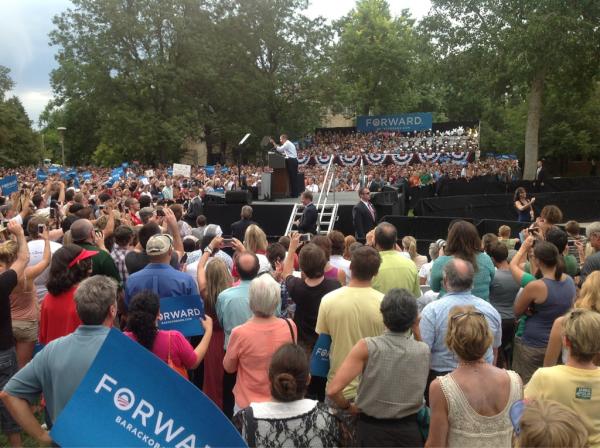
President Obama Addresses Colorado Students About 2012 Election

Maggie's Mind Mumbles//: President Obama Addresses Colorado Students


President Obama came to visit Colorado State University on August 28th. He was here in 2008 and I just barely missed him. He was a senator running for president back then. I was a scared freshman, and the Oval was outside of the comfortable bubble I had created for myself (dorm room, classes, Lory Student Center, and Corbett dining hall).


This time around I was determined to see him. My President Obama adventures began around 10:30 am on August 27th. That’s when I just happened to walk by a girl handing out tickets on my way to carry out a completely different mission (Print flyers for the first meeting for the CSU Range Club). She was just setting up so I didn’t even have to wait in line to get this shiny blue ticket.

Behind the scenes photos:


Obama's Helicopter via @EllyCollins


Security via @SarahJaneKyle


Secret Service via @SarahJaneKyle


Behind these curtains you can find metal detectors and a weaving maze on metal barricades to organize the line of people.

The next stages of this adventure to see President Obama’s speech did not quite go according to plan. First off, I should have realized that the people I passed at 10:00am (some people camped out all night) were clever, instead of scoffing at their time-wasting ways.


Secondly, I should have brought my ticket to school with me this morning instead of leaving it in my lunch box (yes, I am such a logical thinker). My poor boyfriend, Reid, was napping (he works nights now), and I woke him up to bring my ticket between classes.

Third, I should have brought sunscreen and a hat and a parasol and a sunshade and a fan and about 8 gallons of water! It was approximately 5,000 degrees and standing in line in direct sunlight in that kind of heat is probably what death feels like (if you died in the desert of heat stroke and dehydration), especially if your not even sure if it will all pay off.

Fourth, I should have left my backpack with Reid when he brought the ticket instead of lugging it with me to the back of the loooooooong line (My estimates say it was at least a mile long).


Map courtesy of Google Maps
  • Blue box indicates location of speakers
  • Red box indicates security
  • Black line indicates direction of line (Where it ends on East dr. is not necessarily the end, this is just where I lost track of it.)
  • Yellow star indicates where I got into the line
  • Orange star indicates where I left it
*Please Note: Colors have no correlation to party.

After 30 minutes of waiting in line (I moved probably 20 feet in that time, at least I made it to some shade), I was told that IF I made it to the front they would probably send me to a separate line to check my bag before sending me BACK to the back of the line.

I had nowhere to take my backpack AND my phone was dead. The extremely nice woman in front of me in line told me she would save my place in line if I wanted to run home to drop it off. She gave me her phone number and told me to call when I returned in order to find her. She joked that she would be hard to find, about 10 feet away from our current position in the 45 minutes it would take for me to return.


There was a squirrel in this tree. I thought I got it in the picture but it must be a vampire. (squiracula)

So I left my place…


…chugged a bottle of the free H2Obama (witty)…


… snapped this photo of the Elvis selling Obama buttons. I also saw a man selling Baronco shirts (Barack + Broncos = Baronco?)… and rode my bike home.

I was so hot when I got home that I felt defeated and like I never wanted to return to that horrible line. I resigned my self to homework for the night.

My sister, Erica then told me that she had green priority tickets, which gave me a second wind (with priority tickets you don’t have to wait as long in line). I called my friend that was saving my spot in line to tell her that I wouldn’t be returning and thanked her for her kindness. We decided to meet up at Wild Boar Coffee, a coffee shop across the street from campus.


Images inside the Quad:


Via Nick Lyon of the Rocky Mountain Collegian


A few highlights from the speeches:


John Hickenlooper, Governor for Colorado, states, “Barack Obama has your back. Do we have his back?” He then goes on to say “President Obama has more emotional depth than anyone I have ever known, and we are lucky to have him as our president.”


Ken Salazar, Secretary of the Interior, asks, “ Who will be the champion for the middle class? Obama, or the other guy who stands for the top 2%.” He also informs us, “It’s Barack Obama that helped you get into higher education.”

CSU Sophomore Haley Damm-Hamblin introduces the president. Her speech represented her background as a young woman going to university and why this election is important to her.


Finally, Obama takes the stage, and he got me just a jazzed as he always does when I hear him speak. One of his major points throughout the speech was the importance of voting. He encourages us to vote saying, “Your vote will decide where we go from here,” and “You choose the path to get to the future.”

When he says that in the next few weeks his opponent will share his agenda, the crowd boos, to which he says, “Don’t boo. Vote. That’s the best response. Vote, and get some of your friends to vote.” He mentions an online voter registry, GottaVote.com, which he emphasizes the spelling and apologizes to English professors ;) . He then says, “Young people came out in record numbers four years ago." and "Understand your power. If you're going to get cynical, wait till you're older." (hahahaha)

A great moment was when Obama listed all the things WE accomplished in the last four years and a guy yells, “You helped!” to which Obama replies, “I helped a little bit” Hahaha Classic.

He puts the power in our hands, “If we win Colorado, we will win this election. If we win Fort Collins, we will win Colorado.” and “America is counting on you and I’m counting on you.”  Pressure’s on! President Obama is counting on ME!


Via Nick Lyon of the Rocky Mountain Collegian

Another key point in President Obama’s speech was the power of education. He tells us that Mitt Romeny calls us the lost generation but we are not because Obama believes in us: “I believe in you. I believe in the American people. I've seen the passion of this generation.”

He goes on to say that he and First Lady, Michelle paid off their student loans about 8 years ago. He says, “We know what its like.” He emphasizes his commitment to higher education saying that we shouldn’t be making it harder for students to pay off loans than it already is. My question for you: Should we keep college affordable or borrow money from our parents (as Romney suggests)?


Via Nick Lyon of the Rocky Mountain Collegian

A third point emphasized in his speech was ObamaCare, Obama explains that “We passed this law because I care.” ObamaCare has provided 7,000,000 young people with healthcare, given woman access to health care such as birth control, mammograms and pap smears, and has made medicine more accessible to the elderly. "Some of us can't afford the healthcare we need sometimes, no matter how well we plan."

A particularly funny moment in my opinion was the reference to the “Romney-Doesn’t-Care plan,” the health care system we will be left with should Romney be elected.


Via Nick Lyon of the Rocky Mountain Collegian

President Obama also discusses the economy and jobs. Obama says that tax cuts should not be given to those who have already succeeded (if success is measured monetarily) saying, “Tax cuts should be given to the middle-class, small business and students not to those who have already made it.” He wants to "build the economy from the inside out.” “It’s about the middle class and students." (Hey that’s me!)

Obama tells us that his opponent believes, “Renewable sources of energy are imaginary,” Obama asks, “Do we want to be forever dependent on foreign oil or do we want to pursue renewable, clean energy sources?” and that “Renewable energy is the future.”

Obama explains, "Here's the bottom line, Colorado. If the other side has their way ... it wont create jobs." and "I want to make sure taxes are not raised a single dime on first $250k of income."


A few other great points from Obama include, “Help every American have a chance to better themselves.” “We don’t need to refight the battles of the past, we are moving forward, we don't go backward!” Obama is not going to leave any Americans out in the cold, that’s what we’re fighting for.

He questions why people who love each other can’t get married. His response, “The history of our country is not about how many people we can exclude.” and "Ignoring inequality doesn't make it go away."

Obama on veterans: "We're going to have to serve them just as well as they've served us."

He includes some inspirational ideas such as: “You gotta get on board. Its time for change!” (which was responded to by the crowd with a resounding, “Yes we can!”) One of his themes was that he hasn’t finished what’s he’s started, “We've got more work to do!” (To which the crowd began chanting, “Four more years!”). And he tells us, "We are greater together than we are on our own."


He exited to a little Bruce Springsteen, “We take care of our own."


(My dumb ole video of the motorcade from Wild Boar Coffee after the speech. Sorry I didn't follow the limo. I was looking at it but my hands didn't cooperate.)
“Will this be an America where no matter where no matter what you look like, no matter where you come from, no matter who you love, no matter what your last name is, you can pursue happiness?"

As a young person, I feel that Obama understands me. As a student, I believe that Obama appreciate me. As a Natural Resources student specifically, I recognize that Obama values me. As a woman, I know that Obama supports me. I am grateful that I can look back on today as a piece of history that I participated in, and I hope one day this piece of history will be considered the day everything changed.

*UPDATE: Today is a new day and the Rocky Mountain Collegian (CSU's student newspaper) has some interesting articles and things to say about Obama's visit, that I would like to address.

This article compares Obama's 2012 campaign with FDR's campaign in which he has re-elected for four terms due to the creation of the New Deal. These government programs forced Americans to rely on the government for their basic needs. I disagree with this comparison. While Obama did mention that he wants to finish the work he's started, the programs he has introduced are not forced on every American, they give chances to every American. The choice to take these opportunities is left up to the individual.

An article by Caleb Hendrich with the title, "Don't Boo Get Out and Vote," discusses why Obama is focused on getting more votes. Apparently, historically the greater the turn-out of voters the more likely the Democratic party has been to have a victory in both the executive and legislative branches. An interesting point.

While the editorial rejoices in the 13,000 people showing up to support the democratic process, their view is that the fate of the nation does not ride on one day in history or the results of the election in November. They want to encourage people to monitor the government in order to ensure that what is promised also is put into effect.

At the time of Obama's speech there was a smallish (comparatively) gathering of Mitt Romney supporters who met at the corner of University and Meridian Avenues. A report in the collegian quotes one of their number in response to the idea of repealing ObamaCare, " The idea that the government can force you to buy something scares me." My response to you sir: "Where do you think roads and highways, public schools, wildlife protection, national monuments, public transportation, public libraries, open space protection, wetland protection, etc. etc. come from? Your tax dollars, that's where. You've been forced to "buy" things your whole life. Even if you don't use these things every day or they will not benefit you directly, you have to pay for them. ObamaCare simply creates an opportunity for some people in the same way all the other public service we know and love do.


Did you catch President Obama’s speech? What do you like, or dislike, about Obama’s campaign? Romney’s? Are you registered to vote? (Register here)

Friday, March 9, 2012

My Take on the Kony 2012 Campaign

Maggie's Mind Mumbles//: My Take on the Kony 2012 Campaign

We live in the age of the internet and, for better or for worse, Social Media is King.  Facebook, Twitter, Blogging, Pinterest, LinkedIn, Myspace, Tumblr, YouTube.  There are hundreds of sites that are designed to keep us connected, allow us to share ideas,  and make the world feel smaller.  With the invention of smart phones, the drunken bar argument about when an event occurred in history, or who wrote a certain song, or how to pronounce a word is a thing of the past.  My generation have grown up with the equipment and the know-how to look up anything we want to know at any time, without much effort.  Some organizations are using this to their benefit.


This video, according to the caption on YouTube, ”aims to make Joseph Kony famous, not to celebrate him, but to raise support for his arrest and set a precedent for international justice.”  (I believe they really want to make him infamous but that’s just my opinion about word choice)

To summarize the video, Joseph Kony is an evil Ugandan warlord who kidnaps children and uses them as soldiers and sex slaves for his militia the LRA.  Jason Russell has been working through the organization, in which he is an original founder, Invisible Children, for a decade to bring an end to Kony's reign.  They want to catch him this year and they need everyone to know about him.  What they don’t tell you is that according to this article, both the Ugandan army and Sudan People’s Liberation Army, that Invisible Children is working with to find Kony, are just as corrupt.

Invisible Children Inc. has good intentions and I can respect that.  They have their heart in the right place but I’m not so sure about their head.  This article explains why the author doesn’t support the Kony 2012 campaign.

When I began writing this blog, on Tuesday after I first saw the YouTube video. I was inspired.  I was sucked in by good marketing and the need to feel involved.  As I started doing more research on the topic to find the facts behind the video, I realized that I am very confused.

My optimistic, do-gooder side says, “We can do it!  Let’s bring justice!” and my logical questioning side says, “Who are they kidding?  They’re backing the lesser of two evils.”  I want to believe in this campaign but I’m not so sure I want to support Invisible Children.  I want to live in a world where the people have the power to band together and precipitate change but I know it’s more complicated and there are many hoops to jump through.

It’s taken me three days of editing and thinking and discussing and writing to finally come to the conclusion that nothing is ever black and white.  I think the biggest lessons I’ve learn through my research are that just because something is trending doesn’t mean it’s factual, that knowledge is power and to never take something at face value.

Further Reading:
Help me make up my mind: What do you think about the Kony 2012 Campaign?  What is an issue you believe in?

***UPDATE: I know I'm about four months late on this update. Like many other people, I jumped on the bandwagon of this cause and forgot about it after the fad was over. In my blog revamp I saw this post and decided to check up on the campaign's progress. In April 2012 this video was released:


Any thoughts?

Thursday, March 8, 2012

International Women's Day

Short post today... I'm making hummus and granola bars (more on that later)

Google Logo for the day


If you've opened Google today you've seen this image and possibly wondered what it was all about.  Well, it's International Women's Day!  What does that even mean?  Visit this website.

Now for an article: "Subject for Debate: Are Women People?"

How are you celebrating women (even the not people ones) today?